
There Is a Place for You at the Table
Understanding How the Foundation for Petaluma Public Waldorf Is Organized
Our Philosophy
In the past, the Foundation has run on a small, dedicated group holding everything, carrying most of the weight of the work across every area, through every season. But we believe that this work belongs to all of us. Our vision is a bigger, more multi-dimensional organization: legally required officers, board member leads, new folks bringing fresh ideas, and a real acknowledgement of the many volunteers who have already been part of this work.
Being valued in the work of the Foundation requires one thing: showing up in whatever way fits your experience, capacity, and desire to serve. This document exists to make that structure visible, so everyone who's part of this community understands not just what the Foundation is, but how to find their own place of real impact within it.
Who Makes Up the Foundation
The Foundation is organized in layers, not levels. Every layer matters, and every layer is necessary for the work to happen.
Foundation Officers — the Chair, Treasurer, and Secretary, who hold specific legal responsibilities for the corporation.
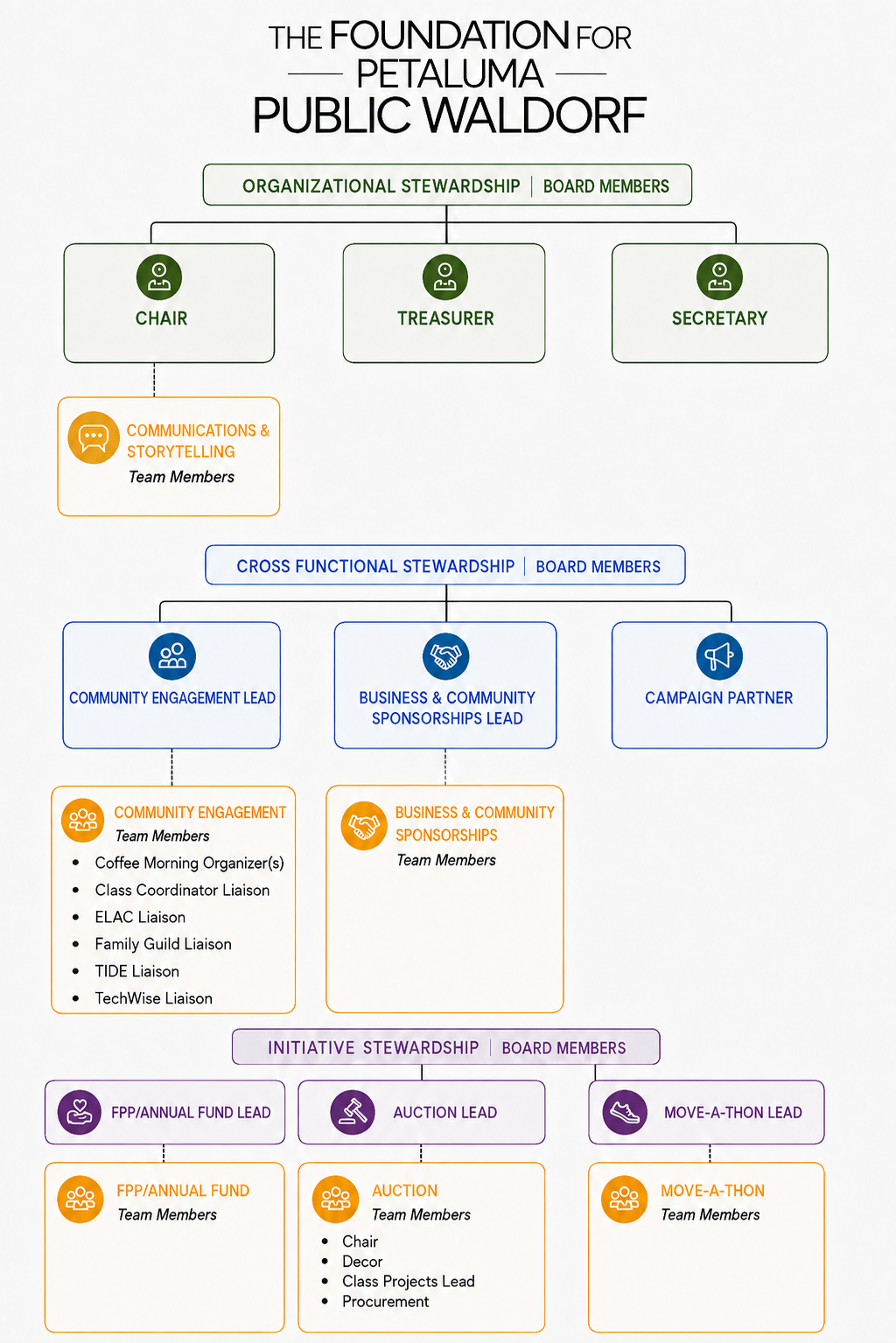
Foundation Board Members — voting members of the Board. This includes our Officers (Chair, Treasurer, Secretary) as well as Board Member Leads, each stewarding a specific area of the Foundation's work (Family Pledge Program, Auction, Move-a-Thon, Community Engagement, Business & Community Sponsorships, Campaign Partner).
Foundation Members — anyone actively contributing to the Foundation's work, whether on a team, at events, or in ongoing roles like coffee morning organizing or class coordination. Many Teams have their own named roles, like Auction Chair, Class Projects Lead, or Class Coordinator Liaison, so as you find your footing, your title can grow more specific right along with your involvement.
Foundation Teams — groups of Foundation members who work alongside a Board Member Lead on a specific area, contributing skills, time, and ideas to that team's success. Current teams are: Auction, Move-a-Thon, Community Engagement, Storytelling Collective, Family Pledge Program, and Business & Community Sponsorships.
A note on language: the Foundation's bylaws refer to non-board contributor groups as "advisory committees." We call them Teams because that's how they actually function, and how we want them to feel.
The Role of a Board Seat
The Foundation's bylaws are specific about this: the Board of Directors is the body that legally exercises the corporation's powers. Practically, that means Board Members are the ones who:
Vote on governance matters (bylaws, policies, board composition)
Vote on anything financial (the annual budget, major expenditures, contracts)
Carry fiduciary responsibility for the organization
Serve two-year terms
This is a meaningful, real distinction, but it's specifically about legal voting authority and stewardship of an initiative area. It's not a measure of who matters more or whose work counts more.
Every Board Member (Officer or Board Member Lead) holds this same seat: the same vote, the same fiduciary duty, the same two-year term. What differs is where their stewardship is focused. Each Board Member wears two hats: governor, helping guide the Foundation's overall direction and health, and steward, leading one specific area of work. The below diagram groups those areas into three categories: organizational stewardship (Officers, keeping the corporation itself legally and financially sound), cross-functional stewardship (work like Community Engagement and Sponsorships that runs year-round and touches the whole community), and initiative stewardship (a specific fundraising campaign, like the Family Pledge Program, Auction, or Move-a-Thon). These are three flavors of stewardship, not three ranks of board membership; every Board Member sits at the same table with the same vote.
What Foundation Membership Means
The bylaws don't define "Foundation member" — it's not a legal category, it's ours. We created it because we wanted a way to name and honor something that was already true: that this organization runs on the sustained work of people who show up for it, year after year, whether or not they hold a board seat.
Foundation membership does come with a responsibility: when you serve on a Team or represent the Foundation in the community, you're representing the whole organization, not acting independently. Teams work under the direction of their Board Member Lead, and ultimately under the direction of the Board — this keeps everyone aligned even as we welcome many different voices and perspectives into the work.
Moving Between Roles
This structure isn't closed. Foundation members who want to take on a Board Member Lead role can submit a letter of intent when a seat opens, and the Board votes on new members. Board Members can also serve on Teams alongside their board role, and can step into a Team-only role if their capacity changes. The goal is fluid movement based on what people can offer and what the Foundation needs, not a fixed hierarchy people have to fight their way into (or off of 😂).
Coming Back to the Table
Every role in this structure — Officer, Board Member Lead, Foundation member, Team — exists to serve one goal: helping every person who wants to help steward our community's resources find their own place of real impact, and know that they are always welcome at the table.